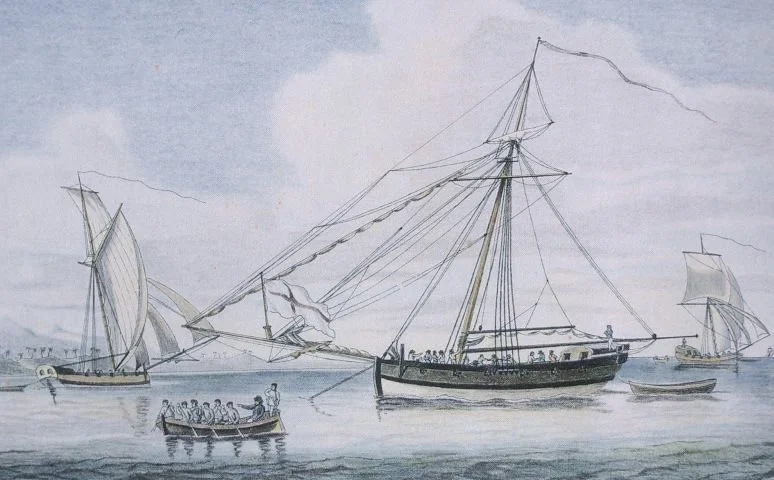
Painting of a privateer off the Coast of Bermuda
With the Declaration of Independence but days old, the Providence Gazette printed notice of “a Court erected to try and condemn all Vessels, that shall be found infesting the Sea Coast of America, and all Vessels belonging to inhabitants of Great Britain and brought into said harbor, to be holden at Providence…”
The newspaper included the public notice concerning the “Capture of the ship called the True Blue…late commanded by James Stable, laden with Rum, Sugar, Coffee, Cotton, Pimento &c taken upon the high Seas and being brought into the Port of Providence aforesaid, and said to belong to Some of the inhabitants of Great Britain, and to have been employed for the purpose of supplying the British Fleets and Armies now acting against the American Colonies, and therefore the said Ship, he Appurtenances, Cargo, and Guns are libeled in the Court aforesaid…”[i]
As the Continental Congress lacked the funds to build the ships for a traditional Navy, the decision was made to issue Letters of Marque and Reprisal to owners of private vessels. The Letter of Marque allowed the passage of a vessel beyond its country’s borders, while a Letter of Reprisal allowed for the use of force and seizure to redress past harms.[ii] Owners of vessels were required to apply for such letters, outfit their vessels, post a monetary Bond before any voyage to ensure proper conduct on the high seas, and pay Admiralty court and Port fees for the captured “prizes” they brought into a friendly harbor.
Merchants whose ships had lain quietly dockside took advantage of this opportunity all along the coastline of New England. The port of Providence alone, registered twenty-five commissioned vessels that first full year of the conflict.
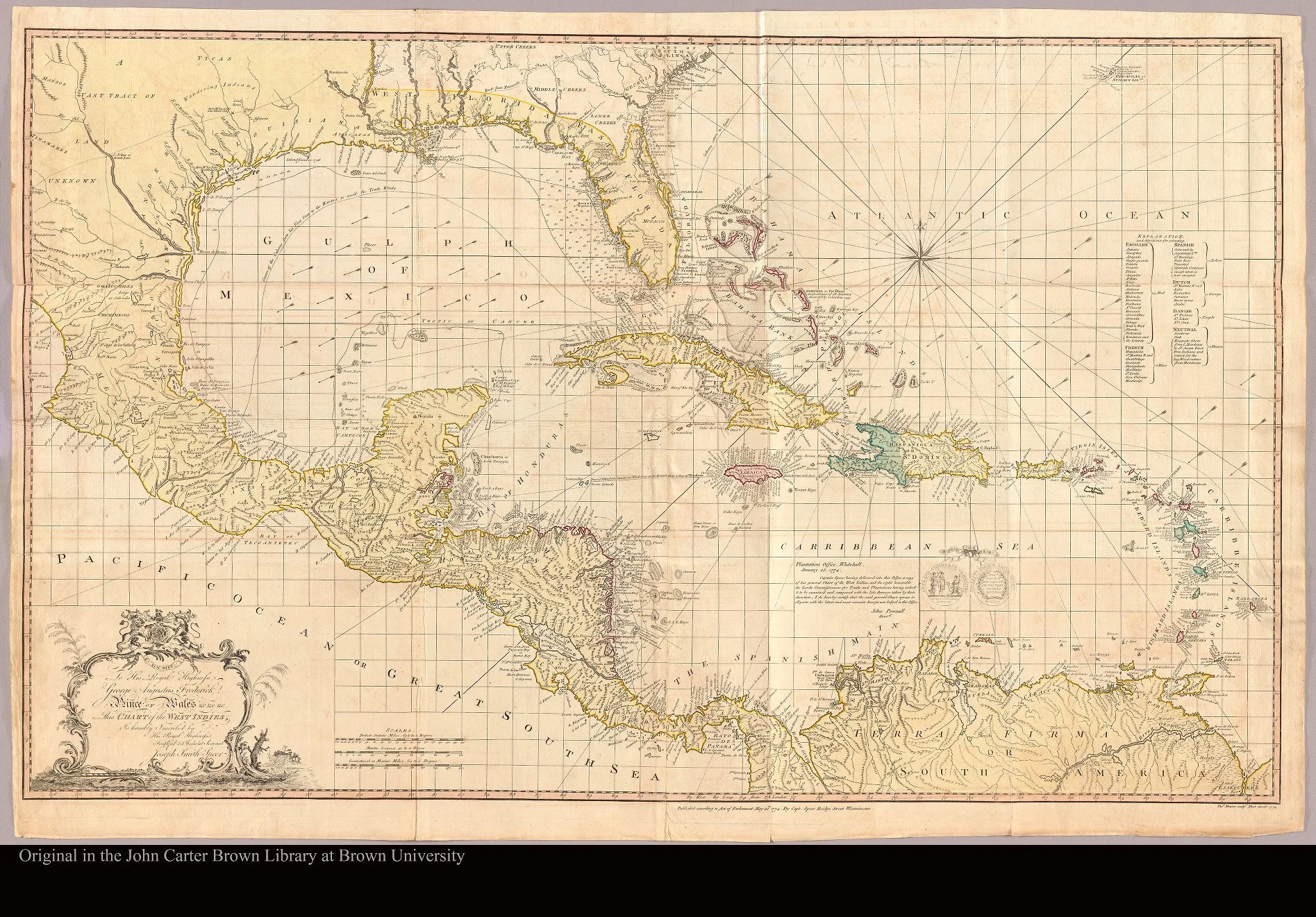
Map showing the necklace of Islands known as the West Indies. Courtesy of Wikipedia Commons
The disruption of trade and shipping to and from the West Indian islands by commissioned privateer vessels in the spring and summer of 1776 meant that shortages by the second year of the American War of Independence were causing a major impact on the islands populations, particularly on Barbados and Jamaica. As shortages of food and supplies increased, the fear of famine became very real. Goods normally shipped from North America dwindled to little traffic, and more urgently, the fear of an uprising among the enslaved population began to panic planter society.
In Barbados, of the estimated 70,000 to 75,000 inhabitants at the time of the conflict only 15,000-20,000 were among the white population.[iii] Jamaica held an even high percentage of people of color, with an estimated population of 192,000 enslaved blacks and multiracial individuals. There were places on the Island where whites were outnumbered by 10-1.[iv]The fear and dread of the planters nearly reached fruition in July of 1776.
A collection of hand copied articles from the pages of the Providence Gazette that summer, show the impact privateering was exacting on the waters of the North Atlantic.
August 17th
Extract of a letter from a planter in Barbados to his friend in London dated May 11, 1776, found on board the ship Eaglelately taken by the Montgomery Privateer of this port.
“I do not choose to meddle with politics yet this I foresee that if matters are not settled with North America this year, we shall all be ruined. I shall not have lumber to make a single cask, with nor even to repair our buildings.”
Extract of a letter dated Barbados, June 15th
“Unless we are blessed with good weather and a continuance of it, I see nothing to prevent a famine. This island is now feeling a great distress as ever was known. It is… now feeling the sad effects of the unholy disputes with America. Yesterday news arrived that General Howe had left Boston and it was thought was going to Philadelphia. Report says that there are many people in Virginia who are Friends to government and only want to be supported by a proper force. I wish the report to be true because the trade to that colony being opened would relieve us very much in Barbados for from thence we chiefly obtain our corn. God grant a happy reconciliation. Our governor tells me he has hopes that matters will be concluded this year from the great amount going to America, first that there will be a bold stroke made this Summer’s campaign. It may be so but I fear it is all in imagination. I begin to be afraid that Great Britain is not able to send a force sufficient to subdue the Americans who are now become obstinate and drove to despair. They are sensible of their own strength (of our) teaching them and indeed we have taught them to fight Numbers there must overpower.”[v]
Extract of another letter dated Barbados, June 16th
“I should have sent you several yams, potatoes &c. but there is much a scarcity that we cannot get them for our own support. I assure you that all kinds of provisions are so scarce it is with the greatest difficulty that we can get them for our own families use. The Lord mend the times for we are at present in a deplorable state.”[vi]
Barbados, June 17th
“My affairs are in the utmost confusion on account of the present disputes which God grant to be soon after and a happy reconciliation which if not soon never will be for depend upon it the Americans will declare themselves FREE and will open their ports to all nations except England. They have at present 80,000 men in (?) as good troops as any nation ever produced besides a militia of 80,000 men always ready to join the Grand Army. Every man from 15-50 is in arms. Their Army is so well supplied with every thing necessary to carry on the war. Their Cruisers (privateers) have taken a great number of English vessels. This and the neighboring islands are in great distress for provisions and in three months there will be a general famine in this part of the world if some speedy relief is not given to them. At present, any man that wants negroes may have as many as he pleases to work for him for their food. You cannot form an idea of the distress that appears in every one’s countenance.”[vii]
Affected as well, were the plantations in North America that had supplied the West Indies with goods for over a century. Early in the conflict, Thomas Cranston, the descendent of Rhode Island Governor Samuel Cranston wrote to Beriah Brown, the high sheriff of Kings County on April 26, 1775 in a strikingly similar tone:
“We are in the utmost confusion and which part we shall take is at present uncertain. I see nothing but destruction coming upon us, look which way I will..there is no person here that knows how to act or which part to take-if we should take up with the part that the government hath adopted we shall be laid in ashes-and if we take up the King’s side we shall have all the sons of liberty upon our backs.”[viii]
Cranston would later be confined to house arrest, a lenient punishment in deference to his family’s service to the Colony. His letter, however, expressed the concerns of many of the owners of the Narragansett Plantations.[ix]
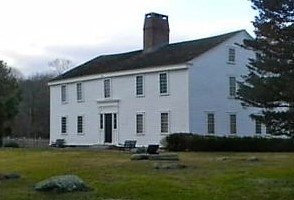
Smith’s Castle, the 18th century Updike Plantation Photo by the author
Those planters along the shoreline relied heavily upon British trade with the West Indies. The Updike’s had their own vessels that sailed directly to and from related plantations in Barbados as they had done from South Ferry and Wickford since the previous century. Now that lifeline had been severed for the first time. The Gardiner’s, Hazard’s, Robinson’s, Stanton’s and others relied upon the ships of merchants Aaron Lopez and Jacob Rivera to buy their grains, lumber, livestock, mutton, and molasses; and deliver them to the Caribbean. The war put an end to such commerce. Wickford fisherman too were affected, their routine exchange of fish netted in the Baltic onto vessels bound for the West Indies now became too much of a risk on the open water.
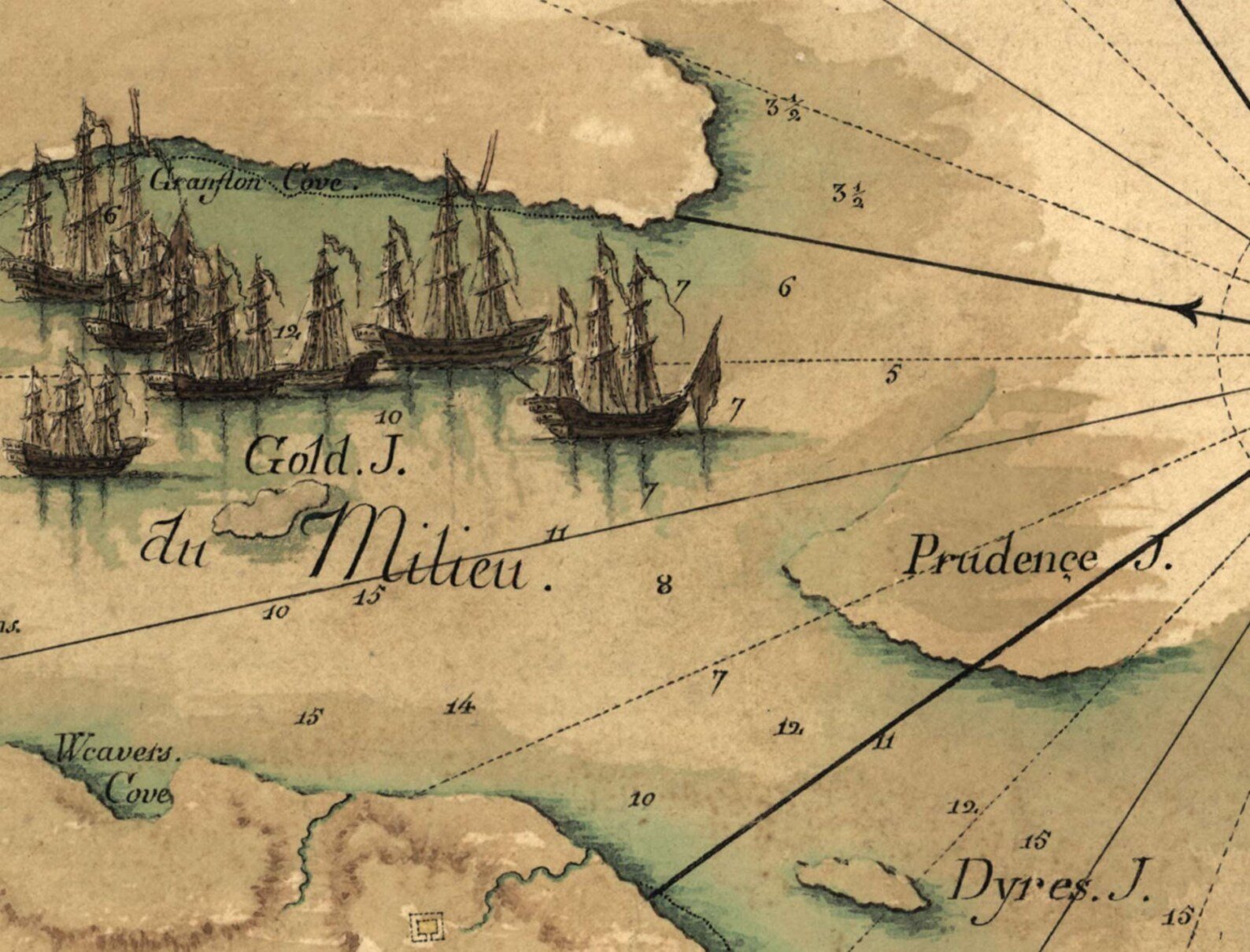
Part a cartouche from a map of Newport, circa 1778 From the author’s collection
Some large landholders left Kings County before they faced ruin. Others, like the Updike’s, stayed and weathered rumors of suspected loyalist tendencies. During the War, they came to rely on revenue from land leasing and rents from property that offset their diminished income from the plantations, even renting out their enslaved laborers for work on other estates, or community projects such as roadwork or bridge repair, often funded by lotteries.[x]
With the clamor of news from Boston, readers from far-flung places might be excused for believing that all the colonies were united in wanting to wage war against Great Britain. Moreover, that so many had enlisted. This explains the writer from Barbados wrong assessment of American troop strength and their capabilities. By June 1776, the primary reason for their world being turned upside down was the success of American privateers. Some 800 vessels were commissioned by the Continental Congress.[xi]
Records of Rhode Island’s privateering show that vessels from sloops to barks and brigantines were fitted with guns for taking prizes. Merchants such as John Brown, Matthew Arnold, Pardon Tillinghast, Jacob Greene, Nathaniel Greene[xii], Silas Casey, and a host of others invested in ships and ventures. Seasoned mariners and men who had never set foot aboard a boat before eagerly enlisted for crews. Each man aboard such a vessel shared in the prizes of a successful voyage. The articles copied below, show the success of these early privateering ventures.
August 10, 1776
“A prize ship mentioned in our last to be taken by the Montgomery Privateer[xiii] Capt. Daniel Bucklin of this port is arrived at Dartmouth. She was bound from Barbados to London. Her cargo consists of 200 Hogshead 40 (?) and 4 barrels of sugar, 106 Hogsheads of Rum, 127 bags and 15 barrels of ginger, 22 bogs of butter, 1 pipe of Madeira wine, and 30 barrels of oil.
Another valuable brig taken by the Montgomery in conjunction with a Salem privateer id arrived at Falmouth.[xiv]
Aug. 10, 1776
“The following is a list of the Men of War ordered by the Congress to cruise of St. Helene to intercept the East India vessels
The Victory 36 guns, the Congress 36, the Dickenson 36, the Freedom 30, and the United Colonies 30 guns.
The Hancock and Adonis Frigates of 32 guns, fitted out by the order of Congress has just put into Lisbon.”
The Refrigal (?) an American ship of war has taken two prizes- a ship and a schooner one from the Grenada’s and the other from St. Vincents bound to England.”[xv]
Sept. 7, 1776
“Thursday last (Sept. 5th) arrived here a prize schooner taken by the Joseph[xvi] privateer, Capt. John Field in consort with a letter of marque Commanded by Capt. Joseph Tillinghast both of this port. She was in ballast and bound from Grenada to Liverpool in Nova Scotia.”
“Capt. Biddle of the Andrea Doria in the service of the United States we hear has taken four valuable prizes, one of them said to be a large ship which Lord Dunmore was sending to England with 15000 bushels of wheat. Two of the prizes have arrived safe in port.”
“We learn that Capt. Jabez Whipple of the privateer Independence[xvii] of this place has taken three valuable prizes viz a ship, Brig, and Sloop. And conveyed them to a safe port.”[xviii]
Sept 14, 1776
“The privateers Montgomery[xix] and Yankee Ranger[xx] of this port have taken three large Brigs bound from the West Indies to England laden with Rum, Sugar, Coffee, and oil. They are all arrived at a safe port.”
“We learn that Capt. Samuel Dunn in a privateer …has taken a large Brig with 260 Hogshead of Rum.”[xxi]
Sept. 21, 1776
“The privateer General Greene[xxii] of East Greenwich and the privateer Harlequin of Baltimore have taken a Jamaican ship of 310 tons and sent her into a safe port. Her cargo consists of 372 Hogshead of Sugar, 82 puncheons of Rum, 36 pipes and 4 Hogsheads of Madeira wine, 1800 pounds weight of (?) &c. This ship we hear sailed in company with a large fleet conveyed by two other Men of War, one of which was seen to leave them, the other said to be a dull sailor was to proceed with them to Europe.”[xxiii]
The feared eruption of a slave insurrection nearly occurred in Jamaica that summer. Letters confiscated from prizes that were published in the Providence Gazette and other newspapers reveal the circumstances and the panic caused by the detailed plan of a violent insurrection.
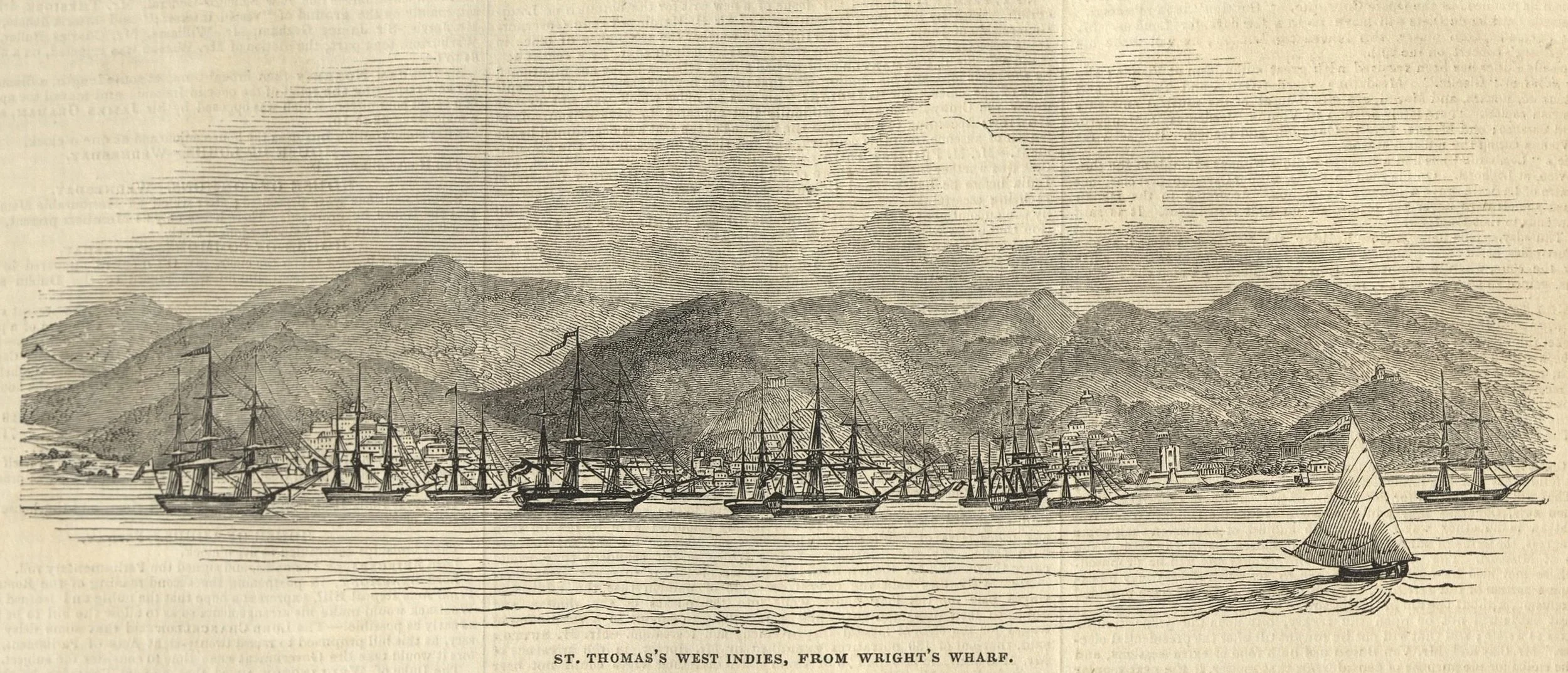
18th century view of St. Thomas Courtesy of Wikipedia Commons
Sept. 28, 1776
Extract of a letter from Montego Bay (Jamaica) dated August 6th and found on a prize ship lately captured:
“The confusion that we have been in here since you left the island on account of the slaves prevents my sending you the articles which you desired. God knows how the affair will end for they are daily impeached faster than they can be taken up, and what is amazing none have yet fled to the woods. It is said they have sent to St. Ann’s to procure a man to Command them there who was concerned in the last Rebellion, but I fancy he will be deterred on hearing of so many of their chief officers being taken up. I was obliged to go to Lucia on the information. Two of the Marrons were accused but it appears at present that only one worthless fellow who never staid at home and is detested by the rest has had any knowledge of it and they wish to have him punished if it can be proved that he has endeavored to represent them as inclined to serve the slaves. One cannot imagine how it has affected my (?) this year. I expect it will ruin me as well as some other planters bit I have not the spirits to write any more on the subject.”[xxiv]
Extract from letter from Jamaica, Hanover Parish August 7, 1776
“The purpose of this is to acquaint you that we are still alive in this Parish. A most horrid conspiracy had been formed by the negroes to cut us all off to a man and even to a white female child. The women were [to be] forced to make concubines for the Ethiopians. Such were their intentions and Sunday the 21st of July. At night was the time appointed for putting the plot into execution, but Providence was kind enough to order it to be discovered the Monday before the 21stsince which time military duty has been very severe. Martial law has been proclaimed and every person without exception is obliged to turn out. There is no intelligence of the negroes in the other parishes having joined them but suppose the massacre was to have been general throughout the island. Scarce anything is now going on in the Parish but taking up trying, hanging, and gibbeting alive though many have been acquitted.” [xxv]
These letters from August 1776 refer to the planned massacre of the families of forty plantations on the island. The enslaved leaders of the plot planned to coincide the attack with the departure of the British 52nd Regiment of Lucea for North America, and support for embattled general William Howe. The plot was exposed, as the letter states, just days before the planned assault when a prominent planter named Edward Chambers found his enslaved house servant replacing the gunpowder for his pistols with black sand.
As reported in the Kingston Journal
“Last week Mr. C[hamber]s, observing his favourite Boy loading his Pistols with Black Sard [stone] was put upon the Watch, and at length discovered a Plot formed by the principal Creole Negroes upon his and four neighbouring Estates for rising the 19th instant It was deep laid, and pretty general. Six Ringleaders have been tried and were hanged on Saturday. Eighty odd more were in custody to be tried. The 52nd regiment consisting of seasoned Men, who had formed Connections here, were forced to embark for America to be replaced by Recruits who die like rotten Sheep. There being no Soldiers in Hanover, or Ships upon the Station, is supposed to have been the Cause of the Negroes rising at a Time when all were engaged on the sailing of the Fleet for England. The Inhabitants are all in Arms and keep constant Guard.”[xxvi]
In the aftermath, many were executed for their roles in planning the uprising. Another letter from Port Ryal, dated August 16th reveals that
“Dear Brother, our present situation is very deplorable. We have been now under arms ever since the beginning of August, on account of an insurrection of the negroes, who have been exceedingly troublesome for some time past, occasioned by the scarcity of provisions, our supplies from America being long cut off. We were in great hopes the execution of about thirty of their ringleaders would have quelled the sedition, but it has not had the desired effect, as they still continue very outrageous, and have laid waste many plantations. A party of the Royal Americans attacked a large body of them, killed 76, and took 86 prisoners, who are under close confinement. This we may thank some of your bloody-minded Ministers for. A ship arrived yesterday, saw a Spanish fleet a few days past of eleven sails, full of men, which alarms us greatly. I will write to you again by the first opportunity, as you must be anxious for our safety. I am, your loving brother, &c.”[xxvii]
The success of Privateers disrupting shipping and travel would continue as the war progressed. The pages of the Providence Gazette that fall informed readers of prize after prize taken by local vessels. The privateers Sally[xxviii], Joseph, Industry, Montgomery, and Eagle[xxix] were reported to have captured several cargoes at the close of summer. The Sally, under Captain Joesph Munro taking a “large Frigate built ship laden with Sugar, Rum, Cotton, Madeira wine, Whale oil & c. bound from Barbados to England.”
The Continental Navy and its commissioned vessels were soon competing with the private merchant vessels for prizes. The newspaper reported the commissioning of ships that summer, and by the fall reports were coming of their success as well:
Oct. 5, 1776
“The same day (sept. 29th) arrived here from a successful cruise the ship Columbus [,] Captain Abraham Whipple in the service of the United States having taken four prizes viz, a Brig from St. Croix bound to Scotland with 265 Hogshead of Rum, 1[?] and 1-2 Barrels of Sugar[,] a Ship from St. Christophers bound to London with 291 Hogsheads 59 Tierces, 23 barrels and 12 Kilderkins of Sugar and 15 Hogsheads and 3 barrels of Rum, a ship from Grenada bound to London with 300 Hogsheads of Sugar, 57 Hogsheads of Rum, 1 pipe and 2 hogsheads of wine, and some cotton[,] a Brig from Montserrat bound to Cork with 218 Hogsheads of Rum…Two of the above prizes are arrived at the Eastward…”[xxx]
Oct. 12, 1776
“Capt. Arthur Crawford of this place has taken and sent safe into port a ship from London bound to Quebec with Blankets, woolen clothes, Irish linen sheetings, [?], shoes, stockings, Scot brandy, port wine,…cheese…
Her cargo when she sailed was estimated at Fifteen Thousand pounds sterling. He has likewise since taken two ships from Jamaica.
Tuesday last (Oct. 8) arrived from a cruise the Sloop Providence[,] Capt. Jones in. the service of the United States. During her cruise she took 13 prizes most of them fishermen six of which she burnt or sunk after taking out their hands and ordered the others to different Ports. One of them has arrived in the Eastward…
Capt. Coffin in his Favorite privateer of this port has taken a ship from Jamaica bound to London laden with Sugar, Rum, limes, Pimento &c. This prize has also arrived in a safe harbor.”[xxxi]
Such contention over prizes continued even as the naval might of Great Britain, France, and Spain began fighting in earnest over the Islands. Such prizes, however, did little to help the war beyond the disruption of British supplies and commerce. This was as Congress wanted, but in their zeal to entice owners to fit out their vessels for such ventures, they agreed that much of the bounty would be divided among owners, captains, officers, and crew. Privateer captains were required to post monetary bonds for cruises, and Admiralty Courts collected fees and a percentage on the value of the cargo, but such benefits for the ports, owners of fleets and mariners, left the soldiers of the Continental Army on land high and dry.
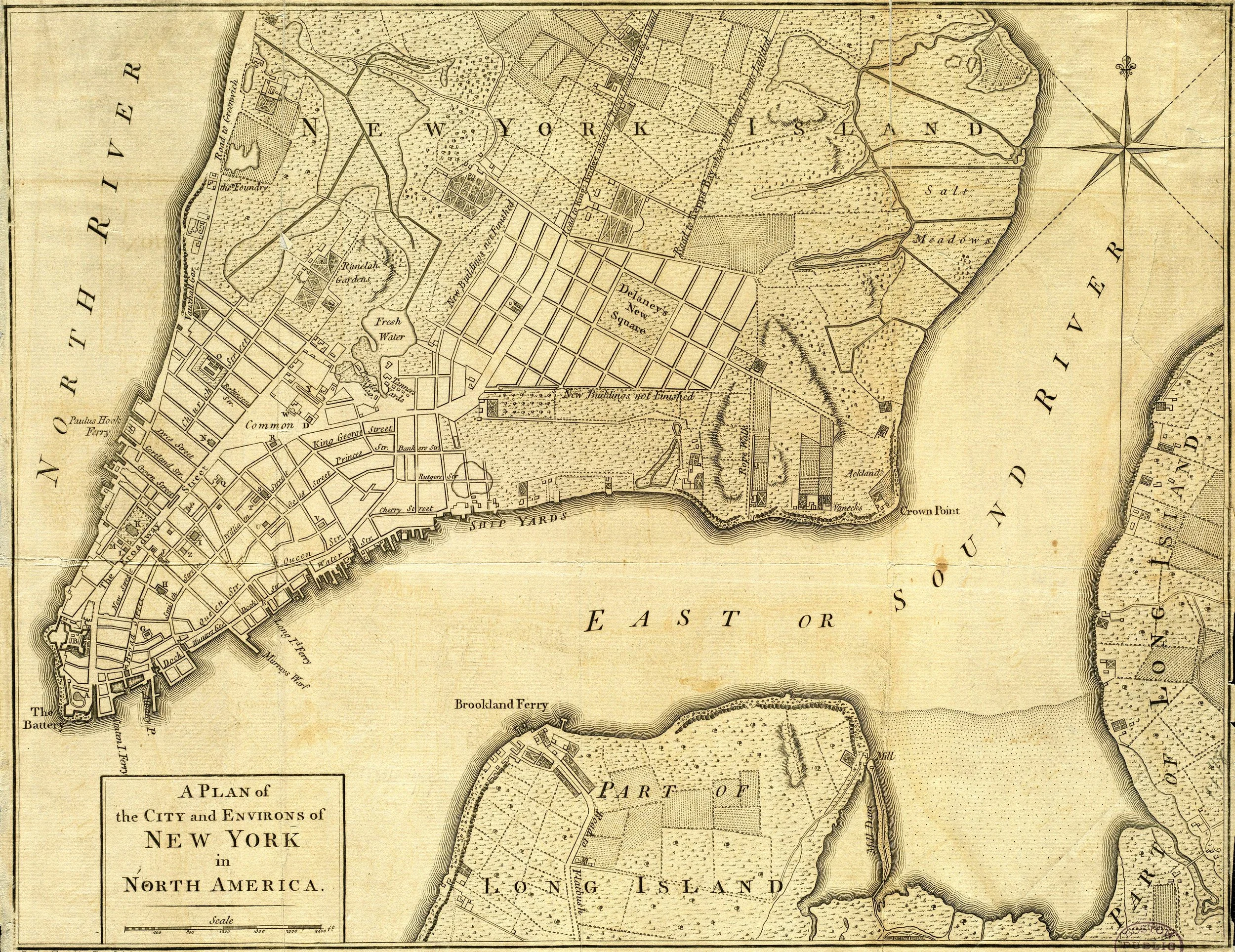
Map of New York City, circa 1776 Library of Congress
At the same time these events were published, General George Washington was writing from the Heights of Harlem, after his Army’s retreat from Manhattan:
“Men are deserting. Soldiers are disobeying. Troops are leaving in conveys…Disheartment, defeat, and enjoining the deserters is followed by many others. The ship seems to be sinking. I may be the only one left on it…
Our Army of men have families back home who suffer in their absences. They have mouths to feed, bills to pay, relationships to grow, and loved ones to whom they long to return. To hold an army from all that, requires reward of the most basic expectations – clothing, shelter, weapons, powder, and pay. Congress must realize that these men are making investments in freedom that are unmatched by any other on this continent.”[xxxii]
The plight of the Grand army of the Republic would worsen in the weeks ahead, until surprise victories at Princeton and Trenton in December revived Washington’s and the renewed Army’s outlook for the coming spring campaign.
Despite the disruption of supplies and threats of uprisings that persisted throughout the war, most West Indian planters remained on the islands for the duration of the conflict. Their lands were too valuable to abandon. While a previous uprising in the 1760’s had decreased the white population significantly, the sugar plantation owners stood their ground throughout the revolution.
The reason was that despite the war demand for sugar remained high, just as the molasses it produced for the rum it procured continued to drive the trade in human enslavement.
So long as the trade in human traffic provided the income desired, Caribbean planters were determined to cultivate their island colonies as much as wealth and colonization could make them an ex-patriot paradise. Loyalists apparently agreed, as an estimated 60,000 to 80,000 fled Noth America and swelled the Island populations of Bermuda, Jamaica, and Barbados with white refuges at the close of the American Revolution.
[i] Providence Gazette, Saturday, July 4, 1776, RIHS MIcrofilm
[ii] Maureen Taylor Revolutionary War Privateers 1774-1783, Rhode Island Roots, Vol. 52, no. 2, June 2026, 100-112
[iii] Donald Winford, Degrees of Restructuring in Creole Languages
[iv] Kenneth Morgan, Creating an English Jamaica 1655-1775 from A Concise History of Jamaica Cambridge University Press, 2023. https://www.cambridge.org/core/books/abs/concise-history-of-jamaica/creating-an-english-jamaica-16551775/2AE89DA3E182CBFD7316A08FC22A599E
[v] As copied in the handwritten notes of Matthew Arnold from the Providence Gazette August 10, 1776. Matthew Arnold Collection, 029-02, Box 21, Folder 1776,Special Collections, Providence Public Library.
[vi] Ibid.
[vii] Ibid.
[viii] Beriah Brown Papers, Mss 109, Box 4, Folder 7 Rhode Island Historical Society
[ix] The noted eleven Narragansett Plantation owners were the Babcock, Brown, Gardiner, Hazard, Niles, Perry, Potter, Robinson, Stanton, Updike, and Watson families. (Tim Cranston, The Narragansett Planters: Comercial Agriculture in South County https://smallstatebighistory.com
[x] Robert A. Geake, In Their Master’s Stead https://www.smithscastle.org/the-cocumscussoc-review
[xi] John Frayler, Privateers in the American Revolution, National Park Service, https://www.nps.gov/articles/privateers-in-the-american-revolution.htm
[xii] A Providence merchant who routinely advertised the availability of “West India and New England Rum by the Hogshead or smaller Quantity; likewise English steel, Cotton, Wool, &c. &c. &c…. At his store on the West side of the Great Bridge.” (Providence Gazette, March 30, 1776) He was a contemporary of General Nathanael Greene, brother of Jacob, the merchant mentioned this paragraph, and sometimes confused with him by researchers.
[xiii] The sloop Montgomery was owned by Providence merchant Nathaniel Greene and eleven other investors. The sloop was outfitted with ten guns and manned by sixty mariners. (Sidney S. Riders List of Rhode Island Privateers, handwritten notebook, Rhode Island State Archives).
[xiv] As copied in the handwritten notes of Matthew Arnold from the Providence Gazette, August 10, 1776. Matthew Arnold Collection, 029-02, Box 21, Folder 1776, Special Collections, Providence Public Library.
[xv] Ibid.
[xvi] The Joseph was a small schooner owned by Nathaniel Greene and five others. She carried six guns and was manned by a crew of forty-five (Sidney S. Rider’s List of Rhode Island Privateers, handwritten notebook, Rhode Island State Archives).
[xvii] The sloop Independence was registered in Providence on 24 July, 1776. It was owned and commanded by Jabez Whipple.
[xviii] As copied in the handwritten notes of Matthew Arnold from the Providence Gazette, September 7, 1776. Matthew Arnold Collection, Special Collections, Providence Public Library.
[xix] See footnote VII.
[xx] The sloop Yankee Ranger was owned by Joseph Tillinghast, John B. Hopkins, John Brown, and others. One document shows the sale of a 1/16th share of the vessel. She carried four carriage guns (2 pounders) and six swivel guns with a crew of twenty to twenty-five men. She successfully captured three prizes in August 1776 under command of Captains John Warner and Samuel Tripp. The sloop was taken out of commission in June 1777.(Naval Documents of the Revolutionary War, Volume 6, ) https://ibiblio.org/anrs/docs/E/E3/ndar_v06p04.pdf
[xxi] As copied in the handwritten notes of Matthew Arnold from the Providence Gazette, September 14, 1776. Matthew Arnold Collection, 029-02, Box 21, Folder 1776, Special Collections, Providence Public Library.
[xxii] The sloop General Greene was owned by Silas Casey, Jacob Greene, Griffin Greene and four others. She carried sixteen guns and a crew of thirty mariners. (Sidney S. Rider’s List of Rhode Island Privateers, handwritten notebook, Rhode Island State Archives).
[xxiii] As copied in the handwritten notes of Matthew Arnold from the Providence Gazette, September 24, 1776. Matthew Arnold Collection, 029-02, Box 21, Folder 1776, Special Collections, Providence Public Library.
[xxiv] Ibid.
[xxv] Ibid.
[xxvi] Extract of a letter from Jamaica, 24 July 1776, cited in the Public Advertiser, 25 October 1776.
[xxvii] Extract of a letter from Port Royal, Jamaica, dated August 16, 1776, brought by the John and Mary, Captain Jenkins arrived at Falmouth, from Jamaica. Cited in the Public Advertiser, 25 October 1776, General Evening Post, 24-26October 1776, and the London Chronicle, 24-26 October 1776. See https://www.jamaicanfamilysearch.com/Samples2/1776slaverevolt.htm
[xxviii] Ship of uncertain origin, but possibly the Brigantine owned by the Brown family that had suffered a disastrous loss while trafficking enslaved people from West Africa a decade before. https://cds.library.brown.edu/projects/sally/
[xxix] The schooner Eagle carried 8 guns and was commanded by Isaac Field. The privateer was shared by eight investors including John Carter, printer of the Providence Gazette. (Maureen Taylor, Revolutionary War Privateer Lists, 1774-1783, Rhode Island Roots, Vol. 52., No. 2, June 2026, 108-109.
[xxx] As copied in the handwritten notes of Matthew Arnold from the Providence Gazette, September 24, 1776. Matthew Arnold Collection, 029-02, Box 21, Folder 1776, Special Collections, Providence Public Library.
[xxxi] Ibid.
[xxxii] Johnny Teague, ed. The Lost Diary of George Washington, The Revolutionary War Years (Las Vegas, Addison & Highsmith, 2023) 143-144.